Sapa: The Tonkinese Alps
The town was located by Jesuit missionaries in 1918, and, attracted by the cool and temperate climate, western arrivals soon transformed Sapa into a pleasant hill station. Along with a church, they constructed hotels, tennis courts, an airport, hydro-electric station and summer villas. Most were abandoned or destroyed during the subsequent war for independence with the French and a border skirmish with the Chinese, but some of the colonial influence remains. Although the name Sapa means "sand village" in Chinese and the town is located within Vietnam, it is home to a wealth of colorful, diverse hilltribes who have steadfastly resisted integration into Vietnamese society and modern life. In fact, the hill tribes, including the Hmong, the Dao, and the Dai, comprise the majority of inhabitants in the area, outnumbering the Vietnamese who have traditionally preferred the warmer climate of the low lands. Indeed, Sapa has been known to get a light sprinkling of snow in the winter.
The hill tribes are the real attraction of the area, wearing traditional dress of hand woven and dyed clothes and silver jewelry (that make the Vietnamese seem like Westerners). They are shy and are wary of foreigners. Usually, only the Hmongs will socialize or let you take a picture. Sapa's most notable site is its central market - a main gathering place for hilltribes from the surrounding villages. Hill tribes congregate there not only to sell handicrafts, jewelry, orchids, mushrooms, and honey, but to also cultivate relations with other groups, play games, and perhaps find a sweetheart. On some weekend evenings, singing courtships and marriages take place. Diversions
include hiking to nearby villages where it is possible to stay overnight, Silver
Falls several kilometers north and a difficult, three-day scaling of Fansipan
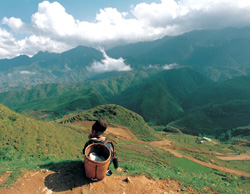
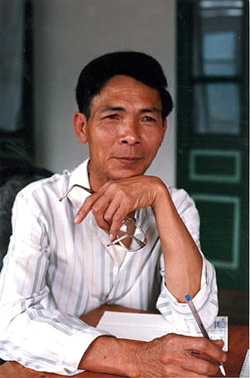
itself. Highlights include Vietnam's highest paved pass, a diversity of hilltribe villages, and exploration of Sapa's mountain wonders and tranquil surroundings. Cold weather and early morning fog blowing off Qui Ho Lake high above Sapa can be expected between December and February. Preferable weather in Sapa is in March and April when the coastal areas are sweltering. Accommodations are at a charming colonial style hotel overlooking the breadth of Sapa's mountain range, terraced rice fields, and deep valley. Tourism has yet to hit Sapa, but during a visit last July the road from Lao Cai was being properly paved, and a small but steady stream of backpackers were beginning to roll in. See our Sapa bicycle tour options or all of our Vietnam bicycle tours. Dang Trung is the proprietor of the popular Auberge of his name in Sapa. Arriving exhausted on a cold, wet night during the Winter of 1992 after bicycling from Lao Cai into a pitch-black Sapa, what few little hotels existed, were all full. An awakened Dang Trung ushered me into his kitchen, stoked a fire and cooked me a hearty meal, then laid a thick mat of bedding over the table I'd just eaten on and tucked me in for the night. In the morning we shared breakfast. Favorite quote (after asked why he spoke such good English and French): "That is history, let us enjoy the present." A kind, gracious man who became a good friend. Patrick Morris, 1993 |